
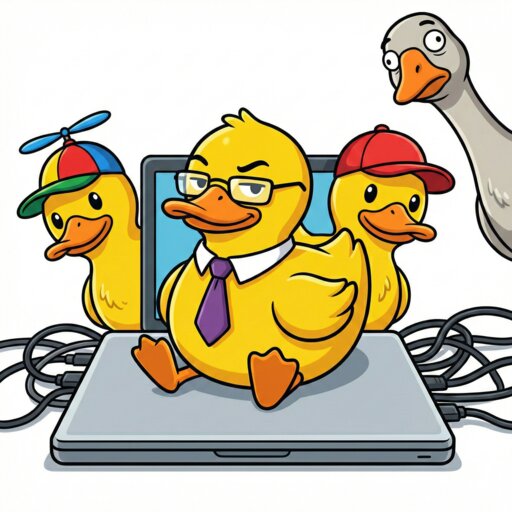
Mcp Rubber Duck
@nesquikm
About Mcp Rubber Duck
An MCP server that acts as a bridge to query multiple OpenAI-compatible LLMs with MCP tool access. Just like rubber duck debugging, explain your problems to various AI "ducks" who can actually research and get different perspectives!
Config
Add this server to your MCP-compatible client using the configuration below.
{
  "mcpServers": {
    "rubber-duck": {
      "command": "mcp-rubber-duck",
      "env": {
        "MCP_SERVER": "true",
        "OPENAI_API_KEY": "<YOUR_OPENAI_KEY>",
        "GEMINI_API_KEY": "<YOUR_GEMINI_KEY>",
        "DEFAULT_PROVIDER": "openai"
      }
    }
  }
}
Tools
15Ask a single question to a specific LLM provider
Conversation with context maintained across messages
Clear all conversation history
List configured providers and health status
List available models for providers
Ask the same question to multiple providers simultaneously
Get responses from all configured ducks
Usage statistics and estimated costs
Multi-duck voting with reasoning and confidence
Have one duck evaluate and rank others' responses
Iteratively refine a response between two ducks
Structured multi-round debate between ducks
MCP Bridge status and connected servers
Pending MCP tool approval requests
Approve or deny a duck's MCP tool request
Overview
What is MCP Rubber Duck?
MCP Rubber Duck is an MCP server that bridges to multiple LLMs—both OpenAI-compatible HTTP APIs and CLI coding agents—inspired by rubber duck debugging. It lets you explain problems to various AI “ducks” and get different perspectives.
How to use MCP Rubber Duck?
Install globally via npm install -g mcp-rubber-duck or use npx directly. Configure API keys in a .env file or config/config.json. Invoke by running the server and using the provided tools (e.g., ask_duck, compare_ducks, duck_debate) from an MCP client. For Claude Desktop, see the dedicated setup guide.
Key features of MCP Rubber Duck
- Universal OpenAI API compatibility for any endpoint.
- CLI coding agent support (Claude Code, Codex, Gemini CLI, etc.).
- Multiple ducks queried simultaneously (Duck Council).
- Consensus voting, LLM-as-judge, and iterative refinement.
- Structured debates (Oxford, Socratic, adversarial).
- 8 reusable MCP prompt templates for multi-LLM workflows.
- Automatic failover, health monitoring, and usage tracking.
- MCP Bridge to connect ducks to other MCP servers.
- Pluggable guardrails (rate limiting, token limits, PII redaction).
- Interactive UIs for compare, vote, debate, and usage tools.
Use cases of MCP Rubber Duck
- Debugging code by explaining problems to multiple AI models.
- Getting multi-perspective analysis on a plan or design.
- Conducting structured debates between LLMs to explore trade-offs.
- Generating and refining responses collaboratively between two ducks.
- Evaluating and ranking LLM responses using another LLM as a judge.
FAQ from MCP Rubber Duck
How does MCP Rubber Duck differ from MCP’s sampling primitive?
MCP Rubber Duck uses direct LLM provider integration, which aligns with the 2026-07-28 spec where server-side sampling was deprecated. It brings its own ducks and does not require the host’s model.
What runtime dependencies are required?
Node.js 20 or higher, npm or yarn, and at least one API key for an HTTP provider or a local CLI coding agent.
Which providers and CLI agents are supported?
OpenAI, Google Gemini, Anthropic, Groq, Together AI, Perplexity, Anyscale, Azure OpenAI, Ollama, LM Studio, and custom OpenAI-compatible endpoints. CLI agents: Claude Code, Codex, Gemini CLI, Grok, Aider, and custom.
Where does data live? How are conversations managed?
Data is handled locally by the server; conversation history is maintained in memory and can be cleared via clear_conversations. API keys are stored in environment variables or config files.
What transports and authentication are used?
The server uses MCP stdio transport by default. Authentication is via API keys configured for each provider; no built-in auth for the server itself.
Frequently asked questions
How does MCP Rubber Duck differ from MCP’s sampling primitive?
MCP Rubber Duck uses direct LLM provider integration, which aligns with the 2026-07-28 spec where server-side sampling was deprecated. It brings its own ducks and does not require the host’s model.
What runtime dependencies are required?
Node.js 20 or higher, npm or yarn, and at least one API key for an HTTP provider or a local CLI coding agent.
Which providers and CLI agents are supported?
OpenAI, Google Gemini, Anthropic, Groq, Together AI, Perplexity, Anyscale, Azure OpenAI, Ollama, LM Studio, and custom OpenAI-compatible endpoints. CLI agents: Claude Code, Codex, Gemini CLI, Grok, Aider, and custom.
Where does data live? How are conversations managed?
Data is handled locally by the server; conversation history is maintained in memory and can be cleared via `clear_conversations`. API keys are stored in environment variables or config files.
What transports and authentication are used?
The server uses MCP stdio transport by default. Authentication is via API keys configured for each provider; no built-in auth for the server itself.
Basic information

More AI & Agents MCP servers

Competitor Tracker & Co.
Competitor Tracker & Co.Competitor Tracker & Co. watches your competitors' websites and tells you what changed. Every week it crawls their pricing, product, messaging and corporate pages, detects the changes that matter, and files a tagged, ran
Transform MCP
UnstructuredThe Unstructured Transform MCP Server connects your ADK agent to Unstructured, a document processing platform that turns raw files into structured, AI-ready data. This integration gives your agent the ability to parse PD

MCP-LLM Bridge
patruffBridge between Ollama and MCP servers, enabling local LLMs to use Model Context Protocol tools

🔎 GPT Researcher
assafelovicAn autonomous agent that conducts deep research on any data using any LLM providers

Web Agent Protocol
OTA-Tech-AI🌐Web Agent Protocol (WAP) - Record and replay user interactions in the browser with MCP support
Comments